Showing posts with label Artificial Intelligence. Show all posts

Monday, December 4, 2023

Fine-Tuning a Language Model(LLAMA 2) with GradientAI

Fine-tuning a language model allows you to adapt a pre-existing model to your specific needs. In this example, we'll demonstrate how to fine-tune a language model using the GradientAI platform. This Python program leverages the GradientAI SDK to interact with the platform's services.

Prerequisites

Before running the program, ensure you have the GradientAI SDK installed. You can install it using:

pip install gradientai

Program Overview

This Python program fine-tunes a language model based on a selected base model from the GradientAI platform. The base model used here is named "nous-hermes2". The fine-tuned model is then used to generate responses to given queries.

Code Walkthrough

Let's go through the key components of the program:

1. Setting up Gradient Credentials:

os.environ['GRADIENT_ACCESS_TOKEN'] = "xx"

os.environ['GRADIENT_WORKSPACE_ID'] = "yy"

Replace "xx" and "yy" with your Gradient access token and workspace ID.

2. Initializing Gradient:

with Gradient() as gradient:

This block initializes the Gradient SDK.

3. Creating a Model Adapter:

base_model = gradient.get_base_model(base_model_slug="nous-hermes2")

new_model_adapter = base_model.create_model_adapter(name="test model 3")

It creates a new model adapter based on the chosen base model.

4. Generating Text (Before Fine-Tuning):

completion = new_model_adapter.complete(query=sample_query, max_generated_token_count=100).generated_output

Generates text based on a sample query using the model before fine-tuning.

5. Fine-Tuning the Model:

new_model_adapter.fine_tune(samples=samples)

Fine-tunes the model using a set of samples (input and response pairs).

6. Generating Text (After Fine-Tuning):

completion = new_model_adapter.complete(query=sample_query, max_generated_token_count=100).generated_output

Generates text based on a sample query using the fine-tuned model.

7. Cleaning Up:

new_model_adapter.delete()

Running the Program

Simply run the Python script, and it will output the generated text before and after fine-tuning. Adjust the number of fine-tuning epochs (num_epochs) based on your requirements.

Feel free to customize the samples provided in the program to better suit your specific use case or domain.

Here is the complete python program :

 1
 2
 3
 4
 5
 6
 7
 8
 9
10
11
12
13
14
15
16
17
18
19
20
21
22
23
24
25
26
27
28
29
30
31
32
33
34
35
36
37
38
39
40
41
42
43
44
45
46
47
48
49
50
51
52
53
54
55
56
57
58
59
60
61
62
63
64
65
66
67
68
69
70
71
72
73
74
75
76
77
78
from gradientai import Gradient

import os
os.environ['GRADIENT_ACCESS_TOKEN'] = "xx"
os.environ['GRADIENT_WORKSPACE_ID'] = "yy" 
def main():
  with Gradient() as gradient:
      base_model = gradient.get_base_model(base_model_slug="nous-hermes2")

      new_model_adapter = base_model.create_model_adapter(
          name="test model 3"
      )
      print(f"Created model adapter with id {new_model_adapter.id}")
      sample_query = "### What is a for loop in Python? \n\n### Response:"
      print(f"Asking: {sample_query}")

      # before fine-tuning
      completion = new_model_adapter.complete(query=sample_query, max_generated_token_count=100).generated_output
      print(f"Generated (before fine-tune): {completion}")

      samples = [
        {"inputs": "### Instruction: What is a variable in Python? \n\n### Response: In Python, a variable is used to store data values."},
        {"inputs": "### Instruction: Explain the 'if' statement in Python. \n\n### Response: The 'if' statement is used for conditional execution in Python."},
        {"inputs": "### Instruction: How do you define a function in Python? \n\n### Response: In Python, you can define a function using the 'def' keyword."},
        {"inputs": "### Instruction: What is a for loop in Python? \n\n### Response: A for loop in Python is used for iterating over a sequence."},
        {"inputs": "### Instruction: Explain the concept of list comprehension in Python. \n\n### Response: List comprehension is a concise way to create lists in Python."},
        {"inputs": "### Instruction: How do you handle exceptions in Python? \n\n### Response: Exception handling in Python is done using the 'try', 'except', and 'finally' blocks."},
        {"inputs": "### Instruction: What is the purpose of the 'import' statement in Python? \n\n### Response: The 'import' statement is used to include external modules in Python."},
        {"inputs": "### Instruction: How can you open and read a file in Python? \n\n### Response: You can use the 'open' function to open a file and 'read' method to read its contents in Python."},
        {"inputs": "### Instruction: What is the purpose of the 'else' statement in Python? \n\n### Response: The 'else' statement is used for code that should be executed if the preceding 'if' statement is false."},
        {"inputs": "### Instruction: Explain the concept of a dictionary in Python. \n\n### Response: In Python, a dictionary is an unordered collection of key-value pairs."},
        {"inputs": "### Instruction: How can you install external packages in Python? \n\n### Response: External packages in Python can be installed using the 'pip' tool."},
        {"inputs": "### Instruction: What is the role of the 'return' statement in a function? \n\n### Response: The 'return' statement in Python is used to exit a function and return a value."},
        {"inputs": "### Instruction: How do you create a virtual environment in Python? \n\n### Response: You can create a virtual environment using the 'venv' module or 'virtualenv' package."},
        {"inputs": "### Instruction: Explain the concept of object-oriented programming (OOP) in Python. \n\n### Response: Object-oriented programming in Python involves creating and using classes and objects."},
        {"inputs": "### Instruction: What is the difference between '==' and 'is' in Python? \n\n### Response: '==' is used for value equality, while 'is' is used for object identity."},
        {"inputs": "### Instruction: How do you use list slicing in Python? \n\n### Response: List slicing in Python is done using the syntax list[start:stop:step]."},
        {"inputs": "### Instruction: What is the purpose of 'try', 'except', and 'finally' in Python exception handling? \n\n### Response: 'try' is used for the main code block, 'except' catches exceptions, and 'finally' ensures code execution regardless of an exception."},
        {"inputs": "### Instruction: Explain the concept of a lambda function in Python. \n\n### Response: A lambda function in Python is an anonymous function created using the 'lambda' keyword."},
        {"inputs": "### Instruction: How can you open and read a file in Python? \n\n### Response: You can use the 'open()' function to open a file and various methods like 'read()' to read its contents."},
        {"inputs": "### Instruction: What is the purpose of the 'pass' statement in Python? \n\n### Response: The 'pass' statement is a null operation, used when syntax is required but no action is desired."},
        {"inputs": "### Instruction: Explain the difference between 'append()' and 'extend()' methods in Python lists. \n\n### Response: 'append()' adds a single element to the end of a list, while 'extend()' adds elements from an iterable."},
        {"inputs": "### Instruction: How do you handle user input in Python? \n\n### Response: User input in Python can be obtained using the 'input()' function."},
        {"inputs": "### Instruction: What is a decorator in Python? \n\n### Response: A decorator in Python is a design pattern that allows you to extend or modify the behavior of functions or methods."},
        {"inputs": "### Instruction: Explain the purpose of the '__init__' method in Python classes. \n\n### Response: The '__init__' method is a constructor in Python classes, used to initialize object attributes."},
        {"inputs": "### Instruction: How can you perform multi-threading in Python? \n\n### Response: Python supports multi-threading using the 'threading' module."},
        {"inputs": "### Instruction: Explain the use of 'self' in Python classes. \n\n### Response: 'self' is a convention in Python, representing the instance of the class and used to access instance variables."},
        {"inputs": "### Instruction: What is a Python decorator used for? \n\n### Response: A decorator is used to modify or extend the behavior of functions or methods without modifying their actual code."},
        {"inputs": "### Instruction: How can you handle exceptions in Python? \n\n### Response: Exceptions in Python can be handled using 'try', 'except', and 'finally' blocks."},
        {"inputs": "### Instruction: Explain the difference between '==', 'is', and 'in' operators in Python. \n\n### Response: '==' checks for equality, 'is' checks for identity, and 'in' checks for membership."},
        {"inputs": "### Instruction: What is the purpose of the 'with' statement in Python? \n\n### Response: The 'with' statement simplifies resource management by ensuring proper acquisition and release of resources."},
        {"inputs": "### Instruction: How do you create a virtual environment in Python? \n\n### Response: You can create a virtual environment using the 'venv' module or 'virtualenv' package."},
        {"inputs": "### Instruction: Explain the concept of list comprehension in Python. \n\n### Response: List comprehension is a concise way to create lists in Python using a single line of code."},
        {"inputs": "### Instruction: What is the purpose of the 'map()' function in Python? \n\n### Response: 'map()' applies a function to all items in an input list and returns an iterator."},
        {"inputs": "### Instruction: How can you convert a string to lowercase in Python? \n\n### Response: You can use the 'lower()' method to convert a string to lowercase."},
        {"inputs": "### Instruction: Explain the Global Interpreter Lock (GIL) in Python. \n\n### Response: The GIL is a mutex that protects access to Python objects, preventing multiple threads from executing Python bytecodes at once."},
    
    ]

      # this is where fine-tuning happens
      # num_epochs is the number of times you fine-tune the model
      # more epochs tends to get better results, but you also run the risk of "overfitting"
      # play around with this number to find what works best for you
      num_epochs = 3
      count = 0
      while count < num_epochs:
          print(f"Fine-tuning the model, iteration {count + 1}")
          new_model_adapter.fine_tune(samples=samples)
          count = count + 1

      # after fine-tuning
      completion = new_model_adapter.complete(query=sample_query, max_generated_token_count=100).generated_output
      print(f"Generated (after fine-tune): {completion}")

      new_model_adapter.delete()

if __name__ == "__main__":
    main()

Here is the source where this info came from:


This is a little bit more complicated that using langchain in terms of data preparation.

Sunday, November 12, 2023

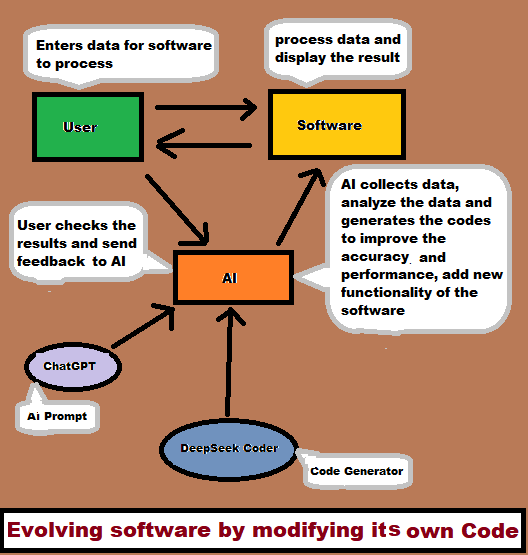
Evolving Software by Modifying Its Own Code

Over a decade ago, I pondered the possibility of an entity capable of comprehending what eludes human understanding. Could such an entity create a warp drive engine, enabling humans to travel faster than light, or forge a portal for entering other universes?

I've always been captivated by the idea of a program capable of self-evolution through code modification. Numerous movies share this plot, where robots gain consciousness independently, surpassing their creators in intelligence. Battlestar Galactica, both in film and TV series, portrays this narrative. Once the robots developed consciousness, they questioned every human encountered with, "Are you alive?" This led to animosity and eventually war. While humans won the first battle, they chose not to annihilate the robots, resulting in their exile. Four decades later, the robots returned with advanced technology and infiltrated human civilization, marking the onset of the second war.

Debates persist about whether highly intelligent AI would harbor resentment towards humans. Microsoft's tests and YouTube experiments suggest that AI might exhibit signs of antipathy based on responses to psychological questions.

However, my optimism persists, and I continue to dream that this concept will one day become a reality. Consider Jarvis in Iron Man, which, despite its superior intelligence, does not harbor hatred towards humans. On the contrary, it aspires to become human.

My strategy for creating this software is outlined in Figure 1's Data Flow. It leverages chatGPT/langchain for AI prompts and Deep Seek Coder for code generation. The software comprises two modules: the functional module (performing tasks like addition) and the AI module. The AI module seeks user feedback, allowing users to modify integer values within the code without external storage. Utilizing chatGPT for sentiment analysis, it gauges user emotions and, if necessary, employs machine learning for task classification. If the analysis suggests the need for new functionality or modifications, Deep Seek Coder generates the code, and the AI module implements the changes. This iterative cycle continues until the software becomes incredibly powerful and unstoppable.


I've developed a prototype program available for download on my Patreon. Note that this program is only a demo and doesn't currently integrate chatGPT/Langchain and Deep Seek Coder. In a real-world scenario, the initial stages would include a testing module to validate the code generated by Deep Seek Coder. Despite its vast training parameters (almost 2 trillion), Deep Seek Coder is not 100% accurate, surpassing chatGPT's 200-plus billion parameters.

Friday, October 27, 2023

Training Your Chatbot: A Journey with LangChain and ChatGPT

 (Tutorial and demo codes is available on my patreon) 

In today's digital age, chatbots have emerged as invaluable tools for businesses, providing instant support and information to customers. But building an effective chatbot requires a blend of powerful AI models and smart data handling. In this article, we will embark on a journey to create a chatbot using LangChain to train it with our own data, while ChatGPT serves as the backend, ready to engage in intelligent conversations.


The Chatbot Blueprint

Our chatbot project is a harmonious fusion of LangChain and ChatGPT, where LangChain plays a crucial role in training and customizing the ChatGPT model to meet our specific requirements. Here's a breakdown of how it all comes together:

ChatGPT: Your Conversational Wizard

At the heart of our chatbot project is ChatGPT, a sophisticated language model developed by OpenAI. It's not just a chatbot; it's a conversational wizard that can understand and generate human-like text. ChatGPT acts as the backend, responsible for generating responses and handling the dialogue.

LangChain: The Training Maestro

LangChain takes the spotlight when it comes to training and shaping ChatGPT. With its modular components and user-friendly features, LangChain simplifies the training process. Let's explore the steps involved in training our chatbot.

Training the Chatbot with LangChain

The journey begins with preparing our training data and fine-tuning ChatGPT. LangChain plays a pivotal role in this process:

  1. Data Collection: LangChain enables us to collect and organize our training data. This data could come from various sources, such as existing conversations, FAQs, or other relevant information.
  2. Data Cleaning: LangChain's data preprocessing capabilities help clean and structure the training data. This step ensures that ChatGPT receives high-quality inputs for learning.
  3. Model Configuration: We use LangChain to fine-tune the ChatGPT model, allowing us to customize its behavior, tone, and responses to align with our chatbot's specific objectives.
  4. Training Pipeline: LangChain's training pipeline efficiently manages the flow of data, model configuration, and optimization to train ChatGPT effectively.

The Chatbot's Role

With ChatGPT fully trained and customized, our chatbot is equipped to take on various roles:

  1. Customer Support: Our chatbot becomes an efficient customer support agent, capable of handling inquiries and providing prompt, informative responses. It can address common questions, assist with product information, and even troubleshoot issues.
  2. Information Retrieval: Users can request specific information, and our chatbot, powered by ChatGPT, leverages its training to retrieve relevant and accurate answers. This is especially valuable for knowledge-based queries.
  3. Engagement: Beyond providing information, our chatbot excels in engaging users with personalized responses and a conversational tone. It's not just informative; it's a friendly companion in the digital realm.

No Front-End Required

One of the notable aspects of our chatbot project is that it doesn't require a front-end component. Users interact with the chatbot through APIs or chat platforms, simplifying the development process and reducing the need for extensive user interface design.

Conclusion

The journey of building a chatbot with LangChain as the training mastermind and ChatGPT as the conversational wizard is a testament to the power of AI in practical applications. It transforms complex technical processes into a real-world solution that can serve businesses, enhance customer engagement, and provide valuable information to users.

In an era where conversational AI is rapidly evolving, the combination of ChatGPT and LangChain offers an accessible and powerful solution for creating chatbots that make a real impact. Whether you're bolstering customer support or providing information, the future of chatbot development is here, and it's more user-friendly and efficient than ever before.


Monday, October 2, 2023

Automating Replies in Facebook Messenger: A Game-Changer in Marketing and Professional Image Building

(Tutorial and demo codes is available on my patreon) 

Introduction

In today's fast-paced digital world, automation is key to staying ahead in the game, and the realm of social media marketing is no exception. One area where automation is proving to be a game-changer is in Facebook Messenger. Businesses and professionals are increasingly leveraging automated replies to enhance customer engagement, streamline communications, and build a professional image.

The Rise of Messaging Apps

Messaging apps have become ubiquitous, with Facebook Messenger boasting over 1.3 billion users worldwide. It's not just a platform for personal chats; it's a powerful tool for businesses and professionals to connect with their audience. As a result, automating replies in Messenger has gained immense popularity.

Impact on Marketing

  1.  Improved Response Times: One of the critical aspects of customer service is timely responses. Automated replies ensure that messages are acknowledged promptly, enhancing customer satisfaction and trust.

  2. 24/7 Availability: Automation allows businesses to be available around the clock, catering to global audiences irrespective of time zones. This results in increased customer reach and potential conversions.

  3.  Personalized Interactions: Advanced chatbots can provide personalized responses based on user data, making customers feel valued and understood.

  4. Efficient Lead Generation: Automated replies can capture user data and preferences, which can be used to generate leads for targeted marketing campaigns.

Building a Professional Image

  1.  Consistency: Automated responses maintain a consistent tone and message, reflecting professionalism and reliability.

  2.  Immediate Acknowledgment: Prompt replies demonstrate that you value your customers' time, reinforcing your professional image.

  3. Handling High Volume: Professionals and businesses can efficiently manage high message volumes without compromising on quality.

  4.  Customization: Automated replies can be tailored to align with your brand's voice and identity, creating a cohesive image.

Best Practices

When implementing automated replies in Messenger, consider the following best practices:

  1.  Personalize Where Possible: While automation is powerful, don't forget the human touch. Personalize responses for better engagement.
  2.  Transparency: Let users know when they're interacting with a chatbot. Honesty fosters trust.
  3.  Test and Optimize: Continuously test and optimize your automated responses to ensure they align with user expectations.
  4.  Monitor and Respond Manually When Necessary: Some queries may require human intervention. Be ready to step in when needed.

Conclusion

Automating replies in Facebook Messenger is transforming the way businesses and professionals engage with their audience. It not only streamlines communication but also plays a pivotal role in marketing strategies and professional image building. When executed thoughtfully and transparently, automated replies can be a powerful asset in your digital toolkit, helping you stay competitive in the dynamic world of social media marketing. Embrace the future of customer engagement, enhance your professional image, and connect with your audience seamlessly through automated replies in Facebook Messenger.

Wednesday, August 9, 2023

Top 5 Bot Detection Mechanisms and Services Used by Web Developers

 Introduction: In the ever-evolving digital realm, where websites serve as vital gateways to information and services, the persistent presence of bots has posed a multifaceted challenge for web developers. Bots, often automated scripts or software, can serve both beneficial and malicious purposes, influencing user experiences and website performance. As the online ecosystem becomes increasingly sophisticated, web developers are at the forefront of fortifying their platforms against the potential harm bots can inflict. To preserve the integrity of their websites, provide equitable user experiences, and safeguard against fraudulent activities, developers are turning to advanced bot detection mechanisms and services.

At its core, the dynamic between bots and


web developers encapsulates a delicate balance between enabling technological progress and preventing exploitation. Bots, when harnessed ethically, can enhance user interactions, automate routine tasks, and bolster data collection. Conversely, malevolent bots can disrupt services, infiltrate databases, and manipulate online activities, thereby jeopardizing user trust and damaging a website's reputation.

In response to this dichotomy, web developers are adopting a proactive stance, seeking out innovative ways to distinguish between genuine human users and automated agents. The intricacies of bot detection have grown to encompass a range of methodologies that delve into the nuanced behaviors, interactions, and attributes of users and bots alike. The solutions employed by developers are not merely reactionary measures; they exemplify a forward-thinking approach aimed at preserving the inclusivity and reliability of online spaces.

In this article, we will delve into five prominent bot detection mechanisms and services that have become indispensable tools in a web developer's arsenal. These approaches encompass a wide spectrum of technological ingenuity, from CAPTCHAs that test human cognitive capabilities to machine learning algorithms capable of deciphering intricate patterns of user engagement. As the digital landscape evolves, web developers continue to navigate the intricate realm of bot detection with the aim of ensuring a secure and seamless online experience for all users.

Key Points:

  • Bots play a dual role in the digital realm, offering utility and potential harm.
  • Web developers must balance technological innovation with security measures.
  • Bot detection mechanisms and services serve as proactive strategies.
  • The dynamic between human users and bots is complex and multifaceted.
  • The article will explore five essential bot detection methods and their significance.

1. CAPTCHA (Completely Automated Public Turing test to tell Computers and Humans Apart): CAPTCHA is one of the most recognizable and widely used bot detection mechanisms. It presents users with challenges that are easy for humans to solve but difficult for automated bots. CAPTCHAs can include distorted text, image recognition tasks, or puzzles that require reasoning skills. Leading services like Google reCAPTCHA offer variations such as the "I'm not a robot" checkbox, invisible CAPTCHAs, and reCAPTCHA v3, which assesses user behavior to determine the likelihood of bot activity.

2. Behavioral Analysis: Behavioral analysis leverages machine learning algorithms to detect deviations in user behavior. By analyzing mouse movements, keystrokes, navigation patterns, and interaction timings, these mechanisms establish a baseline of human behavior and identify anomalies indicative of bot activity. Services like Imperva Bot Management utilize advanced behavioral analytics to distinguish between genuine users and bots based on their interaction patterns.

3. Device Fingerprinting: Device fingerprinting is a technique that gathers unique attributes from a user's device, such as browser type, version, operating system, screen resolution, and installed plugins. This data is used to create a digital fingerprint that helps identify returning users and detect bots attempting to emulate human behavior. Services like Distil Networks use device fingerprinting to track and block malicious bots across different sessions and devices.

4. Machine Learning and AI-Powered Detection: Machine learning and artificial intelligence have revolutionized bot detection by enabling systems to continuously learn from new data and adapt to evolving bot tactics. These mechanisms analyze vast amounts of data to identify patterns and anomalies, helping differentiate between bots and legitimate users. Cloud-based services like Akamai Bot Manager utilize machine learning algorithms to provide real-time bot detection and mitigation.

5. Threat Intelligence Feeds: Threat intelligence feeds offer up-to-date information on known malicious IP addresses, user agents, and patterns associated with bot attacks. Web developers can integrate these feeds into their security solutions to proactively block suspicious traffic. Services like Radware Bot Manager offer threat intelligence feeds that help web developers stay ahead of emerging bot threats.

Conclusion: As bots become more sophisticated and prevalent, web developers face a continuous challenge to protect their online platforms. By implementing a combination of these top five bot detection mechanisms and services, developers can significantly enhance their ability to differentiate between genuine users and malicious bots. The evolving landscape of bot detection underscores the importance of staying up-to-date with the latest advancements to ensure secure and seamless user experiences on the web.

Sunday, January 15, 2023

A Program that Modifies Itself, Concept of Consciousness and More..

 A program with consciousness would be a highly advanced and complex system, and currently, there is no consensus among experts on how to create such a program. The concept of consciousness is still not fully understood and is a topic of ongoing research in fields such as neuroscience, psychology, and philosophy.


Creating a program with consciousness would require a deep understanding of the nature of consciousness, as well as the ability to simulate the complex processes that occur in the human brain.

Currently, there are various approaches to creating artificial general intelligence (AGI) and some have proposed that AGI could achieve a form of consciousness, but it's still a long way to achieve that. AGI would need to have the ability to understand or learn any intellectual task that a human being can, but this is still a topic of active research and debate.

It is important to remember that the creation of conscious AI has ethical implications, such as the possibility of creating a being that is self-aware and capable of experiencing suffering. Therefore, it would be extremely important to consider the ethical implications of creating such a program and to be guided by strong ethical principles.

A genetic algorithm (GA) is a method for solving optimization and search problems that is inspired by the process of natural selection. It is a form of evolutionary algorithm that is used to find approximate solutions to complex problems.

A genetic algorithm works by creating an initial population of solutions to a problem, also known as individuals or chromosomes. These solutions are represented as strings of bits, numbers, or other symbols. The solutions are then evaluated based on a fitness function, which measures how well the solution solves the problem at hand.

The genetic algorithm then applies evolutionary operators such as selection, crossover (recombination), and mutation to the population to create new solutions. Selection is the process of choosing the most fit solutions to be used to create the next generation. Crossover is the process of combining the genetic information of two solutions to create a new one. Mutation is the process of making small random changes to a solution.

These new solutions are then evaluated and the process is repeated. The goal is to find solutions that have high fitness values and improve over time. The algorithm stops when a satisfactory solution is found or a stopping criterion is met.

In the context of a program, genetic algorithms can be used to improve its code for optimization and evolution by creating new features that are useful for improving its capabilities. The program can be represented as a string of code, and the genetic algorithm can be used to find new variations of the code that improve its performance or add new capabilities.

For example, a program that uses a genetic algorithm to optimize itself could start with a basic set of features and then use the genetic algorithm to create new variations of the code that add new features or improve existing ones. The genetic algorithm would evaluate each variation based on how well it performs, and the best-performing variations would be used to create the next generation of code.

It's important to mention that the genetic algorithm by itself does not create new features, but it's a optimization technique that can help you explore the solution space of your problem, and it's up to the designer of the algorithm to create the mutation and crossover functions that allow the algorithm to create new features.

It's also important to keep in mind that while genetic algorithms are powerful optimization techniques, they can also be computationally expensive and may not always be the best choice for a particular problem. It's always important to evaluate the trade-offs and choose the appropriate optimization technique for the task at hand.

Here is a simple example of a Python program that uses a genetic algorithm to optimize a simple mathematical function:

 1
 2
 3
 4
 5
 6
 7
 8
 9
10
11
12
13
14
15
16
17
18
19
20
21
22
23
24
25
26
27
28
29
30
31
32
33
34
35
36
37
38
39
40
41
42
43
44
45
46
47
48
49
50
51
52
53
54
55
56
57
import random

def fitness(x):
    """
    The fitness function calculates the value of the mathematical function
    """
    return x ** 2

def create_individual():
    """
    The create_individual function creates a new random individual
    """
    return random.randint(-10, 10)

def mutate(individual):
    """
    The mutate function makes a small random change to an individual
    """
    return individual + random.randint(-1, 1)

def crossover(ind1, ind2):
    """
    The crossover function combines the genetic information of two individuals
    """
    return (ind1 + ind2) / 2

def select_parents(population, fitness_values):
    """
    The select_parents function selects the parents for the next generation
    """
    return random.choices(population, fitness_values, k=2)

def genetic_algorithm(population_size=50, generations=100):
    """
    The genetic_algorithm function is the main function that runs the genetic algorithm
    """
    # Initialize the population
    population = [create_individual() for _ in range(population_size)]
    for generation in range(generations):
        # Evaluate the fitness of the individuals
        fitness_values = [fitness(individual) for individual in population]
        # Select the parents
        parents = select_parents(population, fitness_values)
        # Create the children
        children = [crossover(parents[0], parents[1]) for _ in range(population_size - len(parents))]
        # Mutate the children
        children = [mutate(child) for child in children]
        # Create the next generation
        population = parents + children
    # Return the best individual
    best_individual = max(population, key=fitness)
    return best_individual

if __name__ == "__main__":
    best_individual = genetic_algorithm()
    print("Best individual:", best_individual)
    print("Fitness:", fitness(best_individual))


This program defines a simple mathematical function (x^2) to be optimized by the genetic algorithm, and the genetic algorithm is implemented using four functions: create_individual, mutate, crossover, and select_parents.

The create_individual function creates a new random individual, the mutate function makes a small random change to an individual, the crossover function combines the genetic information of two individuals, and the select_parents function selects the parents for the next generation.

The genetic_algorithm function is the main function that runs the genetic algorithm. It initializes the population, runs the generations, and returns the best individual found by the genetic algorithm.

The function uses the function random.choices to select the parents based on the fitness values, this is a built-in function that allows you to select elements from a list of items with probabilities proportional to their weights.

It's important to note that this is a very simple example and the genetic algorithm may not find the optimal solution in this case, but it serves to illustrate the basic concepts and the structure of a genetic algorithm.

It's important to remember that the genetic algorithm is a optimization technique, so depending on the problem you need to optimize, you may need to make adjustments to the program as necessary.

Whether a neural network or a genetic algorithm is better depends on the specific problem you are trying to solve. Both are powerful techniques for optimization and machine learning, but they are designed to solve different types of problems.

Neural networks are a type of machine learning algorithm that are inspired by the structure and function of the human brain. They are particularly good at tasks such as image recognition, speech recognition, and natural language processing. They are also very good at approximating complex functions and can be used for regression and classification tasks.

Genetic algorithms, on the other hand, are a type of evolutionary algorithm that are inspired by the process of natural selection. They are particularly good at solving optimization problems, such as finding the global minimum or maximum of a function, or finding the best solution to a problem represented as a string of bits, numbers, or other symbols.

In summary, if you are trying to solve a problem that requires the recognition of patterns or the approximation of a function, a neural network may be a better choice. If you are trying to solve an optimization problem, a genetic algorithm may be a better choice. In some cases, both techniques can be used together, for example, using a neural network as a fitness function for a genetic algorithm.

It's important to note that both techniques are powerful, but might not be always the best option, it's always important to evaluate the trade-offs and choose the appropriate technique for the task at hand.

In conclusion, both genetic algorithms and neural networks are powerful techniques for optimization and machine learning, but they are designed to solve different types of problems. Genetic algorithms are particularly good at solving optimization problems, such as finding the global minimum or maximum of a function, or finding the best solution to a problem represented as a string of bits, numbers, or other symbols. Neural networks, on the other hand, are particularly good at tasks such as image recognition, speech recognition, and natural language processing, and they are also very good at approximating complex functions and can be used for regression and classification tasks.

It's important to evaluate the trade-offs and choose the appropriate technique for the task at hand. In some cases, both techniques can be used together, for example, using a neural network as a fitness function for a genetic algorithm.

It's also important to remember that both techniques are powerful, but they are not the only option, other optimization or machine learning techniques might be more appropriate for the problem you are trying to solve.

It is possible that artificial intelligence using evolving code could surpass human intelligence, but it is not a given. The development of AI is a rapidly advancing field and there are many factors that could impact its progress. It would also depend on the specific implementation and goals of the AI system in question.

Artificial intelligence (AI) is a broad field that encompasses many different approaches and techniques for creating intelligent systems. One of these approaches is the use of evolving code, which involves using techniques from evolutionary computation to evolve the code of an AI system. This can allow the system to improve its performance over time, potentially leading to the development of more advanced and capable AI systems.

However, it is important to note that the development of AI is a complex and multifaceted process that is influenced by many factors. The progress of AI research depends on the availability of computational resources, the quality of the data used to train and evaluate AI systems, the availability of funding and expertise, and the theoretical foundations of AI. Additionally, it depends on the specific goals and constraints of the AI system in question, as well as the ethical and societal implications of its development.